Introduction
Philosophy was born from a deep human desire to understand the world and our own existence.
Before humans began to reason about nature, justice, or happiness, they were already trying to give meaning to life. But that meaning was found in myths — poetic and religious stories that explained the universe through the actions of the gods.
Around the 6th century BCE, in ancient Greece, a major transformation occurred: humans started to replace divine explanations with reasoning based on observation and logic. This marked the birth of what we call philosophy, literally meaning the love of wisdom (philo-sophia).
Thus, to understand the origins of philosophy is to trace the passage from mythical thought to rational thought, from mythos to logos.
I. Before Philosophy: Mythical Thought
Before philosophy appeared, civilizations already sought to explain the origins of the world and the meaning of life.
However, their explanations were symbolic and religious. Myths served to reassure humans in the face of the mysteries of nature — thunder, death, the seasons, and destiny.
🔹 Example:
In ancient Greece, Hesiod, in Theogony, recounts how the gods were born from Chaos and organized the world.
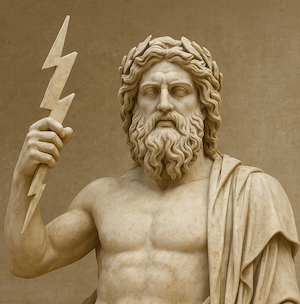
Natural phenomena were explained by divine will: Zeus threw lightning bolts, Poseidon caused storms, Demeter made crops grow.
These stories had moral and religious value, but they lacked rational proof.
Myth relies on belief and tradition, not on reason.
Humans accepted these explanations without questioning them — they believed because they were told to believe.
II. The Greek Turning Point: The Birth of Logos
Around the 6th century BCE, in Greek cities such as Miletus and Ephesus, thinkers began to move away from mythological narratives.
They sought to understand the world through natural causes, rather than divine intervention.
This was the birth of logos — rational thinking based on logic, argumentation, and observation.
These early philosophers are called the Presocratics.
They asked a fundamental question:
“What is the world made of?”
or “What is the principle (archè) of all things?”
🔹 Key thinkers:
- Thales of Miletus (c. 625–547 BCE) claimed that water is the origin of everything, since all life depends on it.
- Anaximander proposed an abstract idea: the apeiron, an infinite and indeterminate substance as the source of all things.
- Heraclitus of Ephesus believed that everything is constantly changing, symbolized by fire.
- Parmenides, on the contrary, argued that being is immovable and eternal, opposing mere opinion (based on the senses) to truth (discovered by reason).
👉 These thinkers no longer believed the world was ruled by capricious gods but by natural laws.
They thus laid the first foundations of science and philosophy.
III. The Golden Age of Greek Philosophy: Reflection on Humanity and Reason
In the 5th century BCE, with Socrates, Plato, and Aristotle, philosophy became a reflection on humanity, society, and truth.
Socrates (469–399 BCE)
Socrates wrote nothing himself but profoundly shaped philosophy through his method: dialogue.
He questioned his interlocutors to help them think for themselves.
His famous motto —
“Know thyself”
— shows that philosophy is not only knowledge of the world but also self-examination.
For Socrates, truth is reached through reason, not tradition or opinion.
Plato (427–347 BCE)
A student of Socrates, Plato distinguished between two worlds:
- the sensible world, changing and deceptive;
- and the intelligible world, that of Ideas, eternal and perfect.
According to him, to philosophize is to rise from the visible to the invisible, from opinion to knowledge.
Aristotle (384–322 BCE)
A student of Plato, Aristotle founded logic and was interested in all fields of knowledge (biology, ethics, politics…).
For him, reason enables us to understand the causes and purposes of things.
He famously declared that man is a political animal, meaning that humans are naturally made to live in society.
IV. Philosophy: A New Way of Thinking
With the birth of philosophy, humans began to think for themselves.
Philosophy does not impose beliefs — it questions, analyzes, doubts, and seeks truth through reasoning.
Conclusion
Philosophy was born when humans decided not to simply believe, but to seek understanding.
From Thales to Aristotle, the Greeks moved human thought from myth to reason, opening the way to science, ethics, and politics.
Even today, to philosophize means to ask fundamental questions about existence, truth, freedom, and happiness — with the same critical spirit as the first thinkers of ancient Greece.