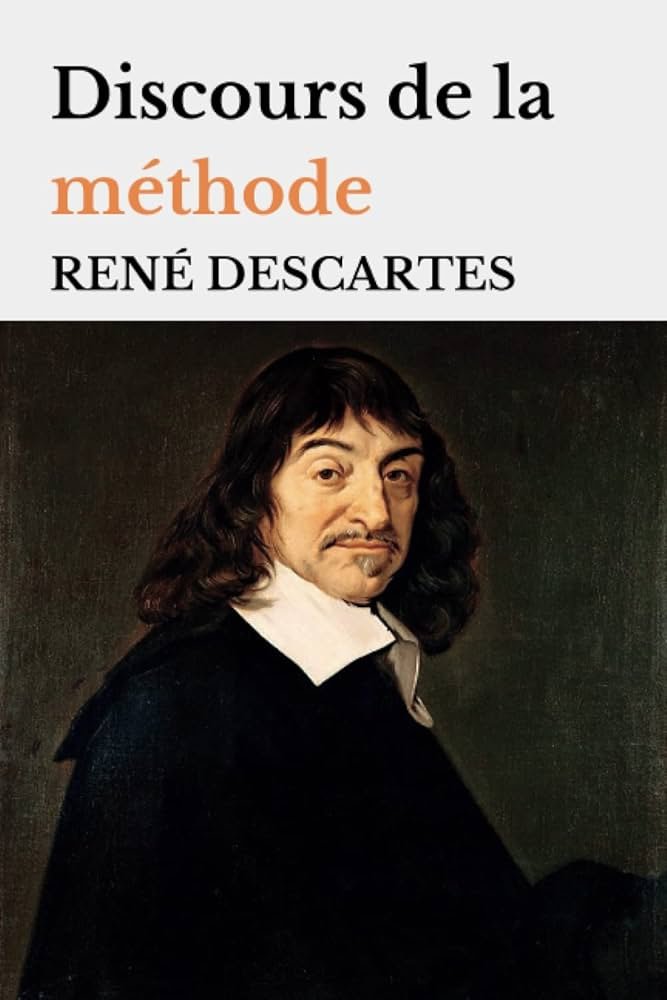
Author: René Descartes
Genre: Philosophical essay (written in French, which was rare at the time)
Goal: To find a method for reaching certain knowledge, just like in mathematics.
🧠 Central idea:
Descartes seeks a universal method to reason correctly and reach the truth. He wants to build solid knowledge that doesn’t rely on the senses or opinions.
🧱 The 4 rules of the method:
In Part 2, Descartes lays out his famous method in four rules:
- Evidence: Accept nothing as true unless it is clearly evident.
- Analysis: Break down problems into as many small parts as needed.
- Synthesis: Move from the simplest ideas to the more complex.
- Review: Make thorough checks to be sure nothing is left out.
💭 Methodical doubt:
In Part 4, Descartes doubts everything (the senses, science, dreams…), but realizes he cannot doubt the fact that he is doubting. Therefore, “I think, therefore I am” (Cogito, ergo sum) becomes the first certain truth.
🧍♂️ Man and reason:
According to Descartes, reason is equally distributed among all people. It’s not intelligence that differs, but how we use it. That’s why he offers a method that anyone can apply.
🔬 Science and God:
He applies his method to science and proves the existence of God as a guarantee of truth (a perfect God wouldn’t deceive us). He wants to rebuild knowledge from clear, certain foundations.
🗣️ Style of the book:
Descartes writes in French in a clear and personal tone. The Discourse is also an intellectual autobiography: he shares his journey, doubts, travels, and his rejection of traditional teachings.
📌 Key points to remember for the exam:
- Main theme: Reason as the foundation of knowledge
- Key concepts: doubt, method, truth, subjectivity, rationalism
- Famous quote: « I think, therefore I am. »
- Related topics: Truth, Reason, Consciousness, Science, Human being