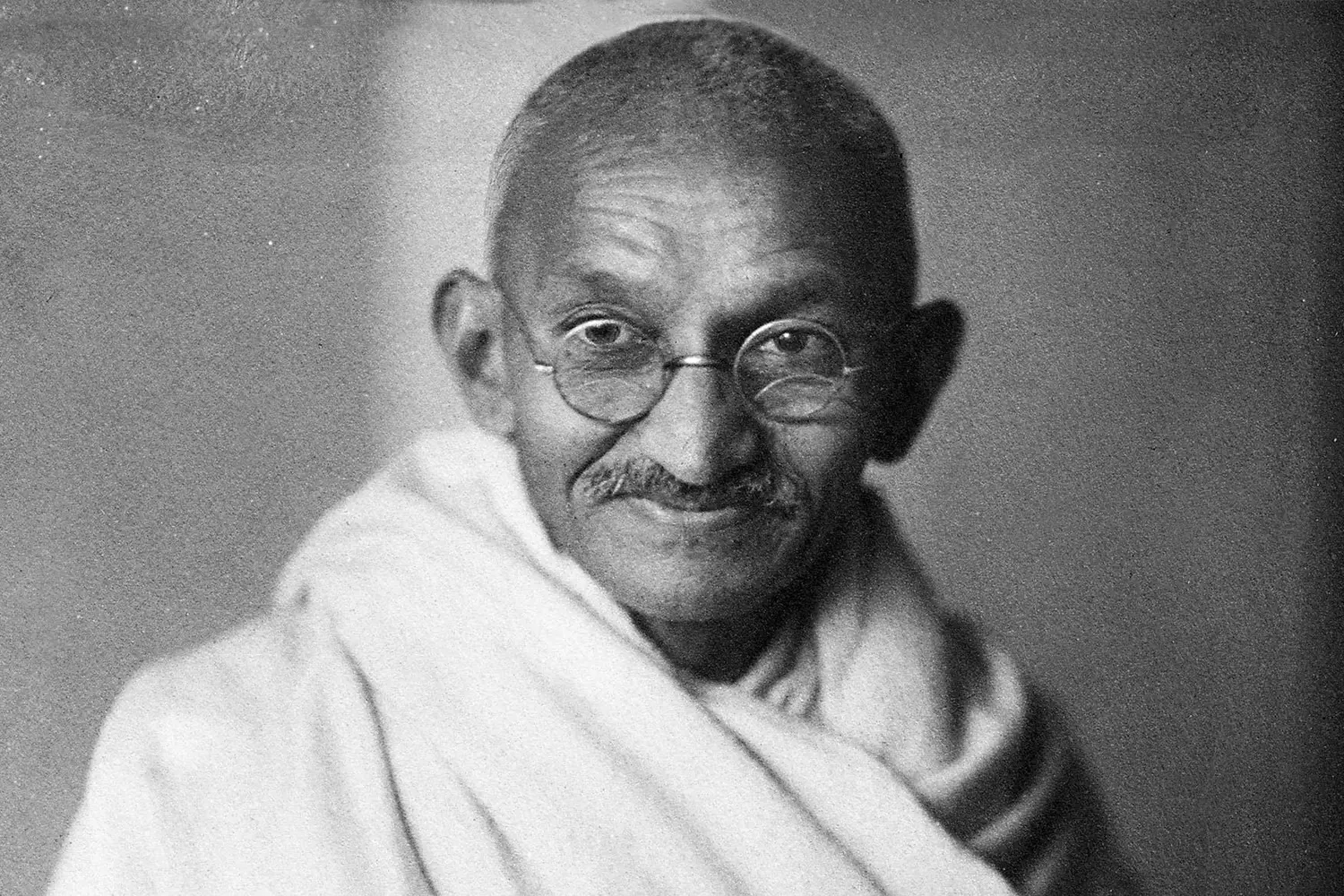
Mahatma Gandhi (1869–1948) was both a moral thinker, a spiritual guide, and a major political figure of the twentieth century. His philosophy is not a purely abstract theoretical system but rather a practical philosophy, oriented toward action and the transformation of both the individual and society.
I. Non-violence (Ahimsa): a moral force
At the heart of Gandhi’s thought lies the principle of ahimsa, inherited from Indian philosophical and religious traditions. Contrary to the common belief that non-violence is a form of passivity, Gandhi understands it as an active and courageous force.
To refuse violence is to refuse to deny the humanity of the other, even when that person is unjust. Violence destroys the moral bond between human beings, whereas non-violence seeks to transform and convert the opponent rather than destroy them.
👉 Key idea: true strength is moral, not physical.
II. Truth (Satya) as a supreme principle
For Gandhi, truth (Satya) is the highest value. It does not merely mean telling the truth, but living in accordance with it. Human beings never fully possess the truth, yet they must constantly seek it.
This search for truth requires humility, since acknowledging one’s own possible error is already a moral act. Politics itself, according to Gandhi, must therefore be subordinated to the demands of truth.
👉 Philosophical link: truth as a moral requirement (Plato, Kant).
III. Civil disobedience: obeying conscience rather than the law
Gandhi develops an original conception of civil disobedience. When a law is unjust, obeying it means participating in injustice. However, disobedience must remain public, peaceful, and willingly accepted.
The goal is not to overthrow order through violence, but to expose injustice by accepting punishment. In this way, individual moral conscience becomes superior to positive law.
👉 Historical example: the Salt March (1930).
IV. A critique of materialism and modern civilization
Gandhi strongly criticizes modern civilization, which he believes is based on excessive material accumulation and technological domination. He advocates a simple life, grounded in self-discipline and self-sufficiency (swadeshi).
According to him, an unjust society is first and foremost a society that has lost its sense of moderation. Material progress without moral progress leads to dehumanization.
👉 Possible philosophical question: Is technical progress necessarily human progress?
V. Service and moral responsibility
Finally, Gandhi’s philosophy is based on the idea that human beings fully realize themselves through service to others. Freedom is not merely a right, but also a responsibility.
Thus, political action cannot be separated from personal ethics: to transform society, one must first transform oneself.
Conclusion
Gandhi’s thought offers an original connection between morality and politics. It shows that justice cannot be achieved through unjust means and that the end never justifies the means. For Gandhi, the true revolution is first an inner one before becoming a social transformation.
📌 For philosophy essays
- Key concepts: ahimsa, satya, civil disobedience, conscience, justice
- Thinkers to compare: Kant, Plato, Rousseau, Hannah Arendt
- Major themes: violence, law, morality, truth, freedom