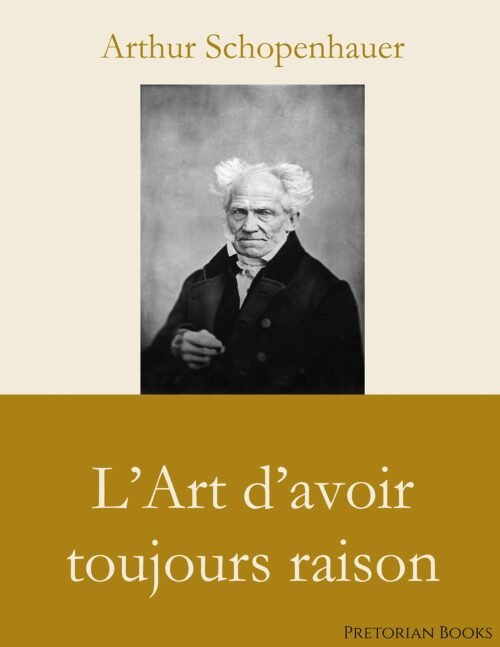
📘 Context and Purpose of the Work
Published posthumously, this short text by Arthur Schopenhauer, a 19th-century German philosopher, is both ironic and critical. The title itself is provocative: it’s not about seeking truth, but rather about how one can “be right” in appearance — that is, win an argument, even when one is wrong.
Schopenhauer explores what he calls eristic dialectic, the art of controversy, which differs from pure logic (which aims at truth) or classical rhetoric (which aims to persuade). It’s essentially a manual of verbal combat.
🧩 Core Principles
Schopenhauer starts from a pessimistic observation:
In real debates, people don’t seek the truth — they seek to defeat their opponent.
Therefore, he presents 38 stratagems that allow one to manipulate, deflect, or neutralize an opponent’s arguments in conversation. These stratagems involve psychological, logical, and rhetorical tactics, often relying on bad faith.
🧷 Categories and Examples of Stratagems
1. Manipulating the Argument
- Exaggeration: Push the opponent’s position to an extreme to make it absurd.
Example: “You want to reduce military spending? Then you want to leave the country defenseless!” - Reductio ad absurdum: Show that the argument leads to an absurd or contradictory conclusion.
- Distraction: Abruptly change the subject to destabilize the opponent.
2. Psychological Tactics
- Ad hominem: Attack the person rather than the idea.
Example: “You never studied economics, so your opinion doesn’t count.” - Emotional appeal: Use pity, anger, or outrage to sway the audience.
- Appeal to authority: Cite an expert or celebrity to shut down the discussion.
3. Performance and Presentation
- Seizing the initiative: Speak first or dominate the tone to assert control.
- Pretending to win: End the debate with a confident statement, even if you haven’t truly refuted anything.
- Using obscure jargon: Confuse the opponent with complex or technical language.
🧭 The Real Purpose of the Text
Schopenhauer doesn’t recommend that readers use all these tactics shamelessly. His purpose is twofold:
- To expose common sophisms found in everyday and political debates.
- To equip the reader intellectually, so they won’t be manipulated during arguments.
Ultimately, he invites us to sharpen our critical thinking, knowing that the art of being “right” can have little to do with truth.
🪞 Philosophical Perspective
This text serves as a critique of human ego and our obsession with appearances — even at the expense of truth. It reflects Schopenhauer’s pessimistic philosophy, in which humans are often driven by pride, rivalry, and illusion rather than rationality.
✅ Enriched Conclusion
The Art of Always Being Right is a brilliant little piece of ironic clarity.
Behind its mocking tone lies a genuine lesson in philosophical critique: a warning against empty rhetoric and a reminder that truth does not always prevail in argument. It is an essential tool for understanding how language and manipulation often replace logic and sincerity.